


Ask five runners how many gels you need for a three-hour race and you'll get six answers. Mostly because they're guessing. I used to guess too. It went badly.
The good news is that it's a sum, and the sum is short.
Why guessing goes wrong
Guess too low and you spend the last hour doing arithmetic you can't finish, wondering why every hill feels personal. Guess too high and you're carrying a pocket full of gels you can't face, with a stomach that has opinions about the ones you did eat.
Both mistakes are common, and both are avoidable. A little planning the week before does most of the work.
Start with time, not distance
Your gut doesn't care about kilometres. It cares about how long you're out there. A quick 30km road race and a slow 20km trail race can both take three, four, five hours, and they need roughly the same fuel.
So work out how long you'll realistically be moving, then add a bit. Races have a habit of running long.
Step 1: pick your carbs per hour
A common target for efforts of around two to three hours is about 60g of carbohydrate an hour. Shorter or easier efforts can get by on less. Longer ones sometimes go higher, but that takes gut training and isn't a number to try for the first time on race day.
Plenty of runners need to build up to 60g from 30 or 40g. Start where your stomach is, not where the internet is.
Step 2: multiply
60g an hour over three hours is 180g. That's your total for the time out there.
Step 3: divide by your gel
Most standard gels carry somewhere between 20 and 25g of carbohydrate, like GU Energy Gel or 32Gi Sports Gel. Some race-specific gels carry far more, such as the Named Sport Race Fuel Gel. The number is on the back of the packet, so read yours.
180 divided by 22 is just over eight. Call it seven to nine standard gels. With a bigger gel the number drops, which is the whole reason to check the label.
Eight standard gels is a gel roughly every 22 minutes, for three hours. Which is a lot of gels.
Step 4: spread the load
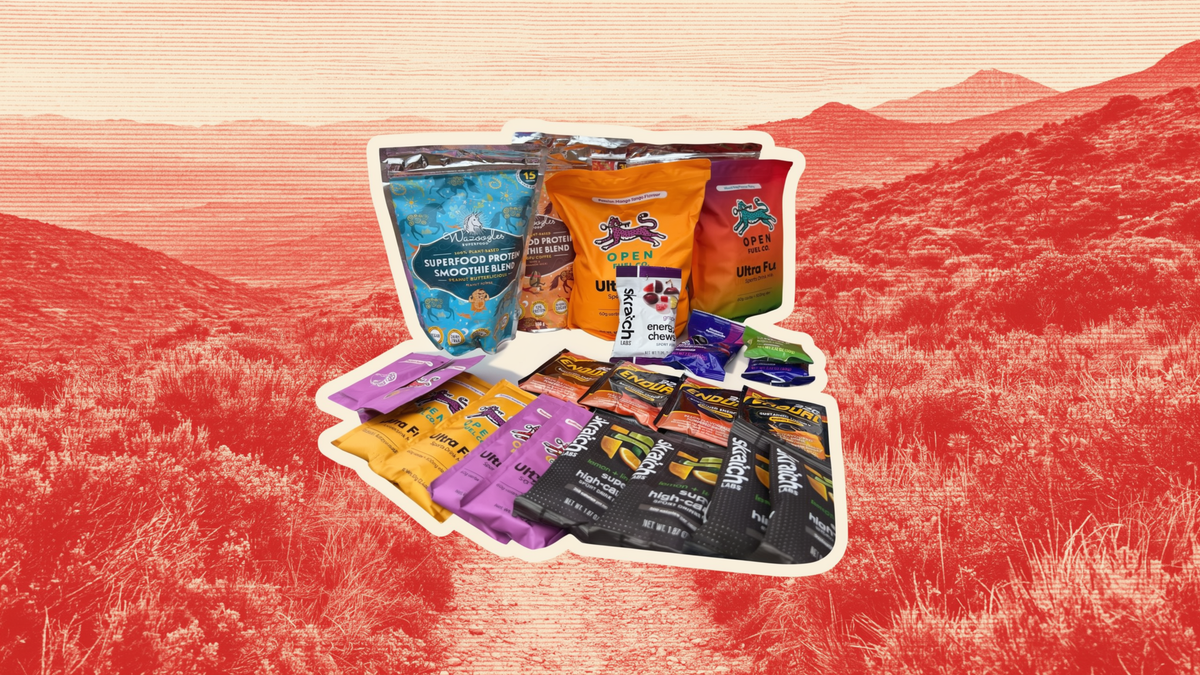
Very few people want to eat eight gels in a row, and not many stomachs enjoy it. Carbohydrate counts wherever it comes from, so a drink mix, chews, a bar or a banana all do some of the work. A drink mix such as Enduren Endurance Drink Mix or Skratch Labs Super High Carb Drink Mix is the easiest way to cover a big chunk of it.
Say your bottle carries 50g an hour. Over three hours that's 150g from the bottle. The other grammage comes from gels and other food.
Read the label on your drink mix as well. They vary a lot.
Step 5: add a spare
Add one or two gels to your number. They get dropped, they burst, and sometimes a mate asks nicely. A spare is cheap insurance. A missing gel at hour 4 is not.
A worked example
Say you're running a trail race and expect to finish in about three hours and fifteen minutes. That's 3.25 hours.
At 60g an hour, you need 195g. You'll carry a drink mix that gives you roughly 30g an hour, which covers about 97g. That leaves around 98g for gels, and at 22g each that's four and a half. So you pack five, plus one spare.
Six gels in the vest, a bottle of drink mix, and a plan to eat every 30 to 40 minutes. That's a plan you can actually follow when you're tired.
Start early, then keep going
Start eating in the first 30 minutes, before you feel you need it. Waiting until you feel flat is how you end up behind, and catching up is harder than staying level.
Little and often beats big and rare. If you plan to eat every 20 to 40 minutes, set a watch alarm. Mid-race brains are not reliable.
Check the aid stations
Find out what's on the course and where. If the race hands out something you've never used, either test it in training or carry your own. Do not let race day be the first time your stomach meets an unknown sports drink.
Then practise it
Run the plan on a long training session. Same gels, same timing, same quantities. If your stomach complains, adjust now, when the only thing at stake is your Saturday morning.
That's the whole point of nothing new on race day. It only works if everything has been tried first. If you haven't settled on a gel, buy two or three different ones and test them across your next few long runs. Single gels run from R29 to R70, so finding out is cheap. Try the Enduren Endurance Energy Gel alongside a couple of the others.
If your stomach tends to complain halfway through a long run, read Why Your Gut Quits Before Your Legs Do before you change the plan.
If you'd rather not do the sum by hand, the Race Kit Planner does it for you. Our Race Day Fuelling guide covers how to build the testing into your training block.
Do the sum, then test it.
Frequently asked questions
How many gels do I need for a half marathon?
It depends on your finishing time. If you're finishing in around 90 minutes, you need less fuel, and a lower hourly carb target usually means just two or three gels. Use the same sum with your own time and a lower number per hour.
Can I use only gels?
Some runners do, and it works for them. Plenty find it heavy on the stomach. Mixing gels with a drink mix or chews spreads the load, and it's worth testing both in training.
Is 60g of carbohydrate an hour right for everyone?
No. It's a common target for efforts of two to three hours, not a rule. If you're new to fuelling during runs, start lower and build up over several long runs.
What if my race takes longer than three hours?
Run the same sum with your own time. Longer efforts sometimes use higher hourly numbers, but that takes practice, so build up in training rather than jumping on race day.
Do caffeinated gels count the same for carbs?
The carbohydrate counts the same. Caffeine is a separate thing, so check the label and keep track of how much you're taking across the race. Our caffeine guide covers dose and timing.


Muscle cramps when running: causes and what helps